
Every CX and CS pitch now seems to include “agentic AI.” The demos are slick, the language is confident, and the story usually sounds like this:
“We plug an LLM with custom prompts into your data, it becomes an agent, and your renewals and expansions magically improve.”
That framing is seductive.
CX leaders know the demos are always slick—but turning them into something real takes forever, which is exactly why it’s a trap.
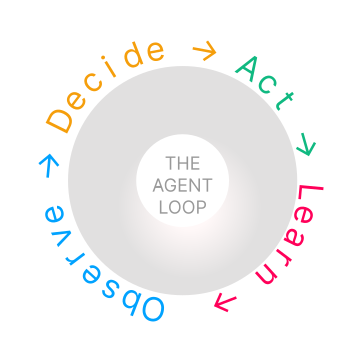
The real unit of design and risk in CX is never the large language model. It’s the agent loop: how the system observes customers, decides what to do, acts in the real world, and learns from what happened. So, Observe → Decide → Act → Learn... Repeat.
That loop quietly controls who gets attention, what they see, and what happens to your revenue. If you don’t design and govern the loop, the model will end up doing it for you.
This article gives you:
When you evaluate “agentic AI” by asking, “Which LLM are you using?”, you’re asking the wrong first question.
The better first question is:
“How does this agent actually run the loop on my customers?”
In CX terms, an agent loop looks like this:
It observes logins, product usage, ARR, segment, tickets, surveys, open deals, renewal dates, and other telemetry signals. It decides who to nudge, who to leave alone, who to escalate, who to re-onboard, and what to include in the business review—without creating nudge fatigue. It acts by sending messages, updating Salesforce, generating decks, opening tasks, triggering plays, and informing CSMs or onboarding reps. It learns who engaged, who improved, who renewed, who churned—and adjusts next time. Then it repeats.
That full loop, with clear boundaries on what it may see and do, is the agent. The LLM—if you use one at all—is just a specialist inside that loop, usually for reasoning and language.
Once you make that shift, the vendor conversation changes from “Our model is better” to something more aligned with how CX leaders actually think: “Here’s exactly what the agent observes, how it decides, what it’s allowed to act on, and how it learns.”
Now you’re evaluating agents, not demos.
Most of what the market calls “CX agents” actually falls into four patterns:
All four can run the same Observe → Decide → Act → Learn loop. What changes is how they decide and how governable they are.
Let’s make each pattern concrete and fast.
Rules-only agents are the playbooks and workflows you already know. This is the oldest pattern and still everywhere in CX. These agents follow simple “if this, then that” logic orchestrated through workflow engines and playbooks.
There is no learning, no machine learning, and no LLM involved.
Take a basic inactive-customer nudge. If a user hasn’t logged in for 14 days, the agent marks the account as at-risk, sends a “We miss you” email, and creates a follow-up task for a human. That’s the entire rules-only agent: simple, explainable, and auditable.
Rules-only agents still matter because they are extremely predictable. Compliance and Legal understand exactly how they behave, and they’re great for SLAs, reminders, and simple lifecycle triggers. The downside is that they don’t adapt. As your products and customers evolve, you end up with sprawling, brittle flowcharts that are hard to maintain and don’t keep up with reality.
Classic machine learning agents are “quiet agents” focused on scoring and prioritization. They learn from data but don’t generate language. Instead, they score, rank, or choose actions and then plug those outputs into your existing processes.
In practice, these are the churn-risk scores, propensity-to-expand models, and next-best-action models you probably already have. For example, a churn-risk scoring agent might observe usage, NPS or CSAT, support tickets, time-to-value, contract term, and other signals. A churn model then outputs a risk score from 0 to 100. Every Monday, the system auto-builds a “Top 50 at-risk accounts” list and assigns plays. Over time, it retrains on which accounts renewed, downsized, or churned.
You may not call these “agents,” but they behave like agents. They are quantitative and defensible, they help allocate limited human attention, and they make it easy to measure lift on renewals and NRR. Their limitation is that they don’t tell the story to the customer. They don’t write QBRs or explain pricing. They still need rules, processes, and humans wrapped around them.
GenAI-first agents are where the LLM sits in the driver’s seat. This is what most vendors mean when they say “agentic AI” today.
In this pattern, the LLM is both the main decision engine and the language engine. Tools and APIs exist to fetch data or execute actions when the model asks for them. For example, a billing question agent might observe by pulling invoices, usage data, discounts, and contract notes. The LLM then decides by inferring why the invoice went up. It acts by drafting an explanation that might be sent automatically for low-risk segments or routed to a human reviewer for key accounts. It learns by storing the question, the answer, and the outcome for reuse later.
When this works, it’s impressive: one system that reads your data, reasons over it, and answers in natural language.
The trouble starts when the LLM is allowed to run the entire loop. If the LLM only drafts and a human decides what to send, risk is limited. But when you let it effectively observe, decide, act, and learn with minimal guardrails, you see inconsistent behavior for similar customers, mistakes that are hard to reproduce and explain, and governance buried in a giant system prompt. That’s the GenAI-only extreme. It demos beautifully and is brutal to productize safely.
Most CX organizations that start with GenAI-first eventually realize they need more structure and control—which leads to the fourth pattern.
Hybrid agents blend rules, search, ML, and GenAI in a governed way. They treat the LLM as one powerful component inside a larger, controlled system.
They combine:
Consider a renewal or a customer intelligence agent. It observes ARR, tenure, product usage, support history, survey scores, open opportunities, and the customer’s segment—effectively everything a good CSM would check before a renewal conversation. Its decisions are orchestrated. Rules determine that if ARR is above a threshold and the renewal is less than 90 days away, a QBR should be generated. ML models contribute churn and expansion scores that shape the story and emphasis. Search or RAG fetches architecture notes, benchmarks, and case studies tailored to that stack and segment.
The agent then acts. GenAI composes a personalized business review with recommendations. The system shares it with actual decision-makers and champions, not just one contact, and opens an “Ask Me Anything” channel grounded in the customer’s own data. It learns by tracking which stakeholders engaged, which sections they viewed, and what questions they asked. That telemetry is fed back to improve both the models and the content for this account and for the wider segment.
Hybrid agents don’t ask the LLM to do everything. They use GenAI where it shines—reasoning and communication—and constrain it where policy, safety, and revenue are on the line. For CX leaders, this is the sweet spot: power and control.
“Safer” in CX is not a vibe; it’s governance.
A CX agent is governable if you can:
By contrast, a non-governable, GenAI-only pattern hides behavior in prompt text and model weights, gives different answers to near-identical customers, and leaves you “governing” by prompting and hoping.
You already know governable systems. Rules-only agents are highly governable and easy to explain. Classic ML agents are governable as long as you understand their inputs, outputs, and how those outputs are used. The key decision now is what you do with GenAI-first and hybrid agents.
You don’t need to become an AI architect.
You do need to own the loop.
A practical way to think about it:
When a vendor pitches you an “agent,” ask them to walk the loop:
If they can’t answer those questions without hand-waving back to “our model,” you’re not looking at a mature agent. You’re looking at a demo wrapped around an LLM.
The conversation about agentic AI is only going to grow.
GenAI-first agents, GPT-style copilots, and LLM wrappers will keep delivering value—especially for prototyping, drafting, internal workflows, and team-productivity AI.
The opportunity for CX leaders is to turn those same technologies into governable, revenue-safe systems that your CX, legal, and executive leaders can confidently stand behind.
Your job is not just to pick a favorite model.
Your job is to control the loop.
Do that, and agentic AI becomes a dependable lever for renewals, expansions, and customer experience—without losing control of the wheel.